The insurance industry is at a crossroads. Carriers are grappling with changing customer expectations, legacy tech debt exacerbating operational inefficiencies, and heavy competitive pressure from digital-first entrants. But the industry leaders we’re talking with are reframing this moment as a once-in-a-lifetime opportunity to reimagine every policyholder interaction through AI-driven automation.
The State of Insurance: Complex, Costly and Customer-Obsessed
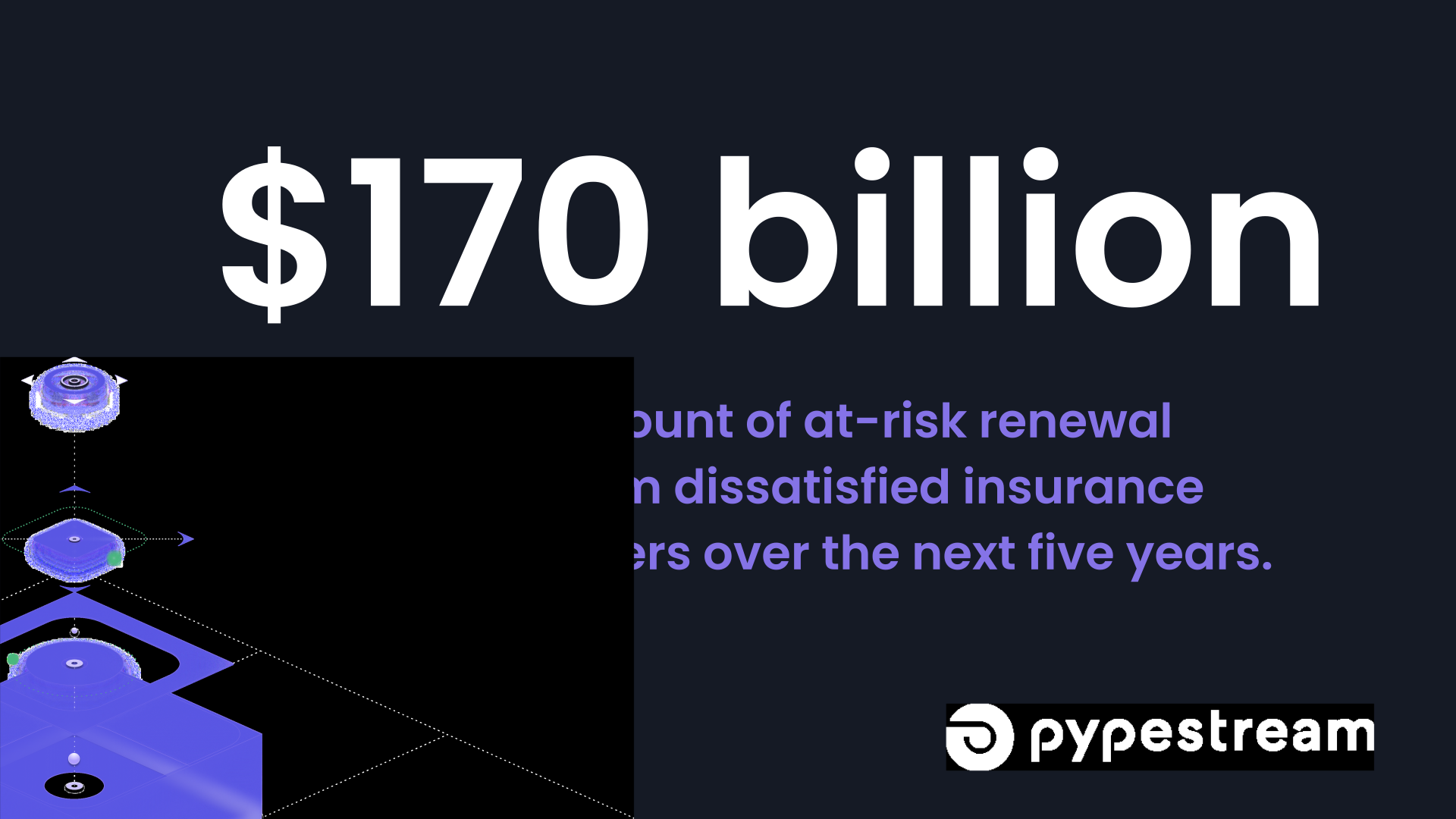
Insurance has always been a business built on trust, responsiveness and reliability. Yet, Accenture reports that one-third of claimants are dissatisfied with their most recent claims experience, with speed of settlement cited as the top frustration. Those dissatisfied customers represent up to $170 billion in at-risk renewal premiums over the next five years, a real threat for carriers who rely on long-term customer lifetime value.
Evolving to meet the new standard of customer expectations is further hindered by longstanding technology debt. According to Gartner, legacy systems consume 60-80% of IT budgets, leaving limited resources to invest in modernization, automation or AI-enabled experiences that customers increasingly expect. These legacy environments also perpetuate inefficient manual processes, fragmented workflows and “swivel-chair” operations that slow down human agents and frustrate policyholders. McKinsey has noted that carriers with high operational fragmentation experience up to 40% slower claims cycle times and higher error rates, directly impacting both cost structures and customer satisfaction.
Meanwhile, digital-native entrants are raising the bar. EY reports that more than 80% of insurance customers are willing to use digital and remote contact channels, like AI-enabled chat and voice, for routine insurance interactions. J.D. Power also continues to show a widening satisfaction gap between carriers that have modernized digital claims and servicing journeys and those that remain constrained by legacy architecture. As challengers differentiate through speed, simplicity and transparency, traditional insurers risk losing market share, particularly among younger policyholders who prize convenience and responsiveness over brand incumbency.
Deloitte reinforces the urgency: carriers that fail to modernize core systems and intelligently automate customer-facing workflows could see operating ratios deteriorate by up to five points over the next three years. Conversely, those that adopt AI-enabled service models, streamline claims submission and approvals, and reduce manual handoffs are capturing measurable business value from reduced loss-adjustment expenses to higher retention and improved NPS.
The message is consistent: Carriers must modernize to restore the speed, transparency and trust that define great insurance experiences.
AI Agents: The Next Step in Insurance Modernization
To avoid getting left behind, carriers must adapt, which today means embracing customer-centric, generative Applied AI solutions, such as AI Agents. AI Agents are conversational, autonomous workflows that can interact in a human-like way and act on behalf of insurers. By combining generative AI with conversational interfaces, AI Agents allow carriers to reduce friction for both customers and employees.
AI Agents, like those solutions provided by Pypestream, enable carriers to securely automate claims, underwriting and policy servicing while providing 24/7, personalized customer engagement through a convenient and user-friendly interface that replicates the experience of chatting on the phone or texting a friend.
Importantly, applied AI does not require a full core-system overhaul to drive meaningful transformation. AI-enabled solutions are designed to sit alongside a carrier’s existing technology stack. They can orchestrate workflows across legacy platforms through secure APIs, integrate and normalize customer data scattered across policy, billing and claims systems, and replace manual, swivel-chair processes with automated, compliant actions. They can seamlessly integrate with core systems like Guidewire, Duck Creek and Salesforce, unifying data and processes across departments. As a result, employees gain a unified view of customer context and can focus on higher-value tasks, while customers benefit from intuitive, self-service journeys that resolve issues quickly without waiting for human intervention. By shifting routine, rules-based tasks into AI-enabled automation, carriers can gradually decommission brittle legacy workflows, reducing the maintenance burden that consumes the majority of IT spend.
Insurers should use this opportunity to reimagine workflows. Applied AI solutions become a modernization accelerant by improving efficiency, accuracy and scalability. Early adopters are already realizing the results of moving from manual, legacy processes to AI-enabled agents. Insurers can now:
- Accelerate Claims Processing: Automate First Notice of Loss (FNOL), adjudication and updates, achieving up to 30% faster claim resolution.
- Enhance Customer Experience: Offer always-on virtual assistants that increase CSAT scores by 25% and reduce call center volume by 35%.
- Boost Operational Efficiency: Automate repetitive tasks in underwriting, data collection, and document processing, reducing costs by up to 60% in customer support operations.
- Improve Fraud Detection and Risk Accuracy: Use real-time data analysis to reduce fraudulent claims by 40% while improving underwriting decisions by 25%.
From Automation to Transformation
Customer expectations are shifting faster than traditional operating models can evolve, fueled by digital-first competitors that are normalizing instant, personalized, always-on experiences. AI is enabling insurers to design entirely new operating models that improve speed, transparency and decision-making across the value chain. Within weeks, insurers can deploy AI Agents that not only respond but personalize and predict, turning every interaction into an opportunity for engagement and growth.
The economics of AI adoption have also never been more favorable. The cost of implementing Applied AI solutions is not burdensome, making it viable to deploy at scale. Meanwhile, customer expectations continue to rise. Policyholders now expect instant claims status updates, policy recommendations and proactive support. As digital-native insurtechs enter the market, traditional carriers must match this level of responsiveness or risk losing customers.
AI technology is no longer experimental. It’s a strategic lever for growth and resilience. As customer expectations rise, workforce capacity shrinks and data complexity increases, AI Agents represent the next era of insurance intelligence: one where digital empathy meets operational excellence.